Shipping Container Storage is the practical system of placing unused or temporarily needed containers in secure yards, depots, warehouses, or private properties. These steel boxes may hold household goods, business inventory, equipment, or construction materials. The process appears simple. It is not always simple.
A storage provider receives the container, checks its condition, records its identification number, and assigns a location. Staff may inspect door seals, flooring, roof panels, and corner castings. Customers usually choose between ground-level access, depot storage, or delivery to their own site. Pricing can depend on container size, rental duration, location, handling, insurance, and transport distance. A 20-foot container offers roughly 33 cubic metres of internal space. A 40-foot unit provides almost twice that capacity.
The scale explains its importance. UNCTAD’s Review of Maritime Transport reports that more than 80% of global merchandise trade moves by sea. Drewry’s Container Forecaster also tracks continuing demand for container equipment, leasing, and repositioning. However, availability changes quickly when ports experience congestion, trade imbalances, or seasonal surges. Christian Roeloffs, CEO of Container xChange, has stated, “Container logistics is ultimately a question of availability, location, and timing.”
That sentence captures the main principle. A container stored nearby may save days and delivery costs. A poorly maintained unit can create moisture, access, and security problems. Reliable operators therefore use documented inspections, controlled access, ventilation planning, and transparent contracts. The model is efficient, but not flawless. Good storage still requires human judgment, accurate records, and regular review.
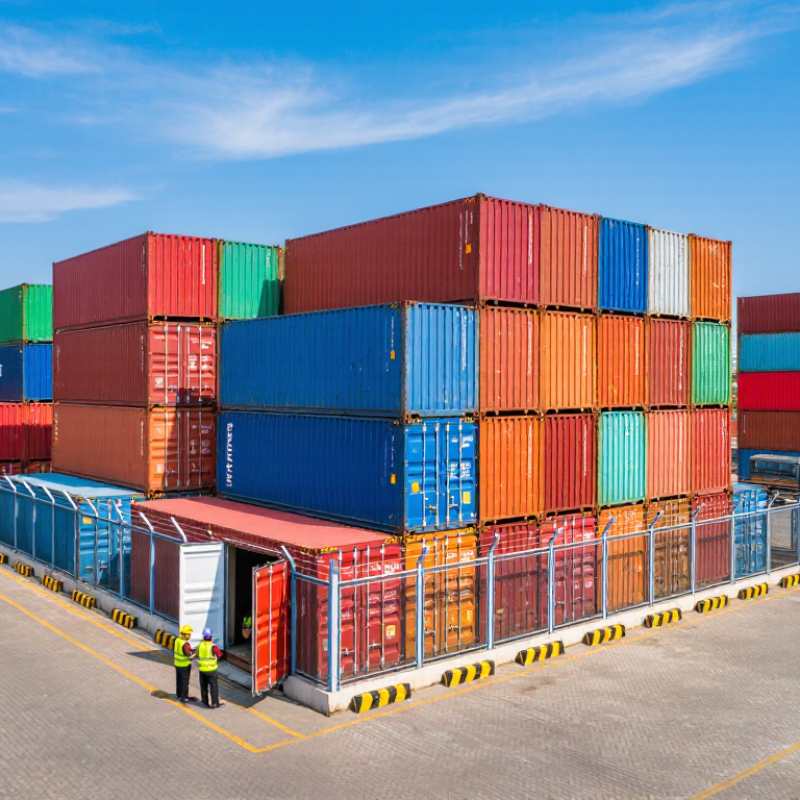
Shipping container storage means keeping standardized freight containers in a secure yard, warehouse, or private property before their next movement. Containers usually measure 20 or 40 feet and follow ISO 668 dimensional standards. They may hold goods, equipment, seasonal inventory, or empty packaging materials. In 2022, UNCTAD’s Review of Maritime Transport reported 12.3 billion tons of global seaborne trade. That volume creates constant demand for temporary storage near ports, factories, and distribution centers.
The process is straightforward. A container arrives by truck, rail, or vessel and receives an inspection. Staff record its number, condition, contents, and storage location. Loaded containers may remain sealed, while empty units can be stacked for later use. Yard operators plan placement carefully, because moving one buried container can require several extra handling steps. The World Bank’s Logistics Performance Index 2023 highlights tracking, infrastructure, and timeliness as key logistics factors. Storage supports all three, but it cannot repair weak planning. That part is often overlooked.
Tips: Choose firm, level ground with drainage. Keep doors accessible. Check seals and moisture regularly. Leave space for safe handling. Ask about fire protection, lighting, insurance, and access records. A low monthly rate may hide transport fees or difficult retrieval rules. Measure your actual inventory cycle first. It is not perfect. Forecasts change, and containers sometimes sit longer than expected.
| Data Dimension | Typical Specification or Process | How It Works in Practice |
|---|---|---|
| Definition | Shipping container storage uses durable, standardized intermodal freight containers as enclosed storage units. | A container is placed at a property, storage facility, construction site, or other approved location, where goods remain inside until they are collected or moved. |
| Common Container Lengths | The most common lengths are 20 feet and 40 feet. High-cube versions are also available and provide additional internal height. | The selected length normally depends on the volume of goods, available ground space, access conditions, and local placement rules. |
| 20-Foot Standard Container | External dimensions are approximately 6.06 m long × 2.44 m wide × 2.59 m high. Internal volume is approximately 33 m³. | It is suitable for household contents, tools, documents, stock, equipment, and smaller commercial inventories. |
| 40-Foot Standard Container | External dimensions are approximately 12.19 m long × 2.44 m wide × 2.59 m high. Internal volume is approximately 67 m³. | It provides roughly twice the internal floor area of a 20-foot unit and is useful for larger inventories or bulky items. |
| High-Cube Container | A high-cube container is generally about 30 cm taller than a standard-height container, with an external height of approximately 2.90 m. | The extra height allows more vertical stacking, but the site must have sufficient overhead clearance for delivery and placement. |
| Interior Floor Area | A 20-foot unit provides approximately 14 m² of floor area; a 40-foot unit provides approximately 28 m². | Floor area helps determine how many pallets, boxes, shelving units, or large items can be arranged without blocking access. |
| Construction | Most units use corrosion-resistant steel walls and a heavy-duty floor supported by steel cross-members. | The rigid structure protects stored goods from impact and weather, although it is not a substitute for climate-controlled storage. |
| Weather Resistance | The steel shell and door gaskets are designed to limit rain and wind penetration when the container is in sound condition and properly closed. | Users should inspect the roof, seams, doors, and floor before storage because damaged seals, holes, and condensation can affect contents. |
| Security | The main doors close with locking rods and can be secured with a suitable heavy-duty padlock or purpose-built lockbox. | The lockbox can shield the padlock from cutting tools, but security also depends on lighting, fencing, surveillance, and access control at the site. |
| Loading and Unloading | Most standard units have wide end doors. Forklifts, pallet jacks, ramps, or loading equipment may be used depending on the site. | Items are loaded through the end opening, arranged to maintain stable weight distribution, and recorded so frequently needed goods remain accessible. |
| Placement Requirements | A firm, level, well-drained surface is recommended. Concrete, asphalt, compacted gravel, or properly prepared foundations may be suitable. | Stable support reduces door misalignment, standing water, floor stress, and difficulty opening or closing the container. |
| Delivery Access | The delivery vehicle needs adequate road width, turning space, overhead clearance, and a clear placement area. | The site is usually assessed before delivery to confirm that the container can be transported, positioned, and removed without damaging property or utilities. |
| Ventilation and Condensation | A closed steel container can experience condensation caused by temperature changes and moisture inside the unit. | Dry goods, ventilation vents, moisture absorbers, pallets, and space between goods and walls can help reduce moisture-related problems. |
| Temperature Control | Standard containers are not normally temperature-controlled or humidity-controlled. | Temperature-sensitive, perishable, pharmaceutical, or humidity-sensitive goods generally require specialized climate-controlled storage. |
| Weight Capacity | Capacity varies by unit. The maximum gross weight and payload must be checked on the container's safety and specification plate. | Goods should be distributed evenly, and the combined weight of the container and contents must remain within the stated limits. |
| Typical Storage Uses | Common uses include household storage, business inventory, tools, building materials, event equipment, records, and seasonal goods. | The container functions as a secure, relocatable storage room without requiring a permanent building extension. |
| Basic Operating Steps | Select the size, inspect the site, arrange delivery, prepare the base, load the goods, secure the doors, and monitor the unit. | When storage is no longer required, the goods are removed and the empty container can be collected, relocated, or returned according to the rental or ownership arrangement. |
| Important Restrictions | Local rules, leases, permits, fire regulations, and property covenants may restrict container placement or use. | Users should confirm permitted locations and avoid storing hazardous, illegal, flammable, or environmentally sensitive materials unless the facility specifically allows them. |
| Inspection Checklist | Check the doors, seals, roof, walls, floor, locking hardware, ventilation, odors, water ingress, and signs of pests. | Regular inspection helps identify leaks, corrosion, condensation, structural damage, or unauthorized access before stored goods are affected. |


Rob was always very honest and upfront about everything and took the time to explain everything I needed.

“highly recommended. They provided us with a great storage container with ontime services.”
“Bought a used container, its perfect, no leaks and in good condition.”
“Good service and prompt delivery. A great option for temporary storage at a decent price.”