7 Best Shipping Container Delivery Companies Worldwide
Choosing a container delivery company is not just a rate comparison. A shipment may begin with a booking and end with a crane lowering a container beside a warehouse. Between those points, schedules can shift, documents need attention, and the delivery site must be ready. Small details matter.
UNCTAD maritime transport specialist Jan Hoffmann has described maritime transport as “the backbone of international trade.” That perspective helps frame this guide. Shipping Container Delivery connects ocean freight with inland transport, equipment handling, and final placement. A low quote may not include every leg. Ask which services are included, who arranges customs documentation, and whether unloading equipment is available at your destination. Confirm access too: a narrow gate or soft ground can complicate a truck delivery.
This overview compares seven companies serving customers across international markets. It considers geographic reach, container options, booking support, transport coordination, and clarity around pricing. Availability varies by route, season, container type, and local partners, so no provider is best for every shipment. Look for written quotes, clear delivery windows, and responsive support. A named contact can make a difference when a vessel arrives late.
Details count. A 20-foot container may suit a compact move, while a 40-foot unit needs more turning space at delivery. These comparisons are useful, but they are not a substitute for checking your route and site conditions directly. Some information can change quickly. The right choice is the company whose service fits the shipment, not simply the one with the boldest promise.
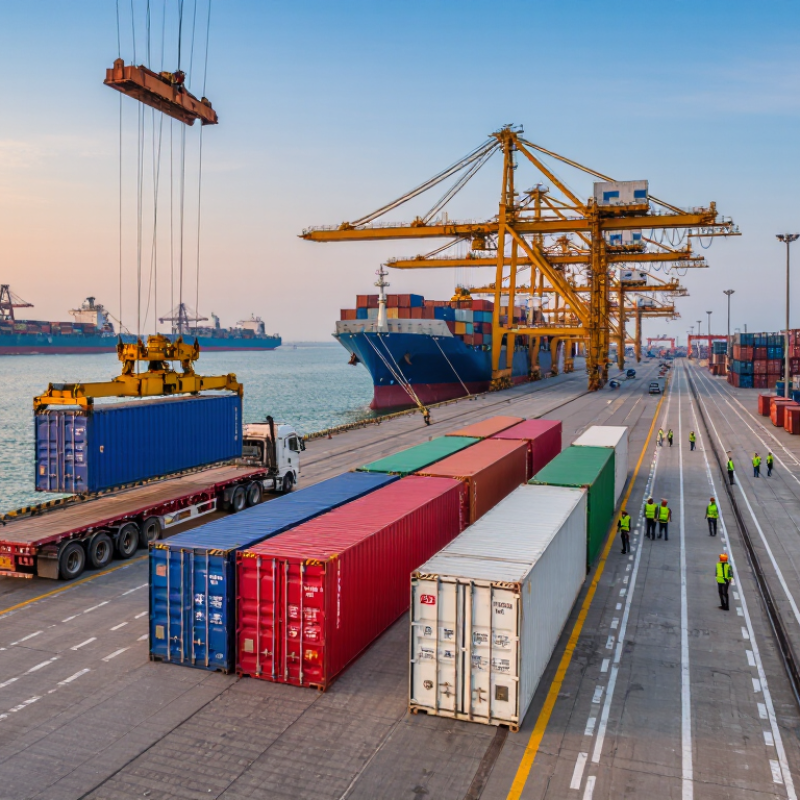
Define Container Delivery Using ISO 668’s Standard 20-Foot and 40-Foot Units
Container delivery means arranging the transport and placement of a freight container at a chosen site. ISO 668 classifies standard freight containers by external dimensions, including the familiar 20-foot and 40-foot units. A standard 20-foot container is about 6.06 metres long; a 40-foot unit is about 12.19 metres long. Both are typically about 2.44 metres wide. These measurements help customers compare equipment and plan transport, access, and placement before a truck arrives.
The stated length is nominal, not usable interior space. Wall thickness, doors, fittings, and container condition affect the room available inside. Height also varies: a high-cube container is taller than a standard-height unit. That distinction matters. A delivery provider should confirm the container type, external dimensions, weight, and site access requirements before dispatch. Check gates, turning space, overhead wires, and firm ground. A truck may need more clearance than the container itself. Measure twice. I would not assume every “20-foot” unit fits the same way; specifications can vary, and that is easy to overlook when planning from a listing alone. Ask for the actual unit’s dimensions and delivery method, then compare them with the intended space.
Container Delivery, Defined by ISO 668: Standard 20-Foot and 40-Foot Units
ISO 668 specifies standard external dimensions for freight containers. Both units are 2.438 m wide and 2.591 m high; the standard 20-foot unit is 6.058 m long, and the 40-foot unit is 12.192 m long. Actual internal dimensions can vary by container design.
Explain TEU: One 20-Foot Container Equals One Twenty-Foot Equivalent Unit
TEU means twenty-foot equivalent unit. It gives ports and carriers a common way to describe container capacity. One standard 20-foot container equals one TEU; a 40-foot container usually equals two. Simple arithmetic. But TEU measures standardized length, not cargo weight or exact usable space. A heavy load may reach its weight limit while leaving room unused. Internal dimensions can also vary by container type, so TEU is useful shorthand, not a perfect proxy.
UNCTAD’s Review of Maritime Transport 2024 reported global container-port throughput of about 858.9 million TEU in 2023. That figure describes port handling, not unique boxes; a container moved between ships can be counted more than once. When comparing delivery providers, check whether a quoted capacity refers to TEU, physical container count, or payload weight. For example, 100 forty-foot containers equal 200 TEU, but remain 100 boxes. Capacity figures alone do not show whether equipment is available for your route or delivery location. Ask for the container size, payload limit, and handling arrangements in writing. A small detail. It can prevent a costly mismatch.
7 Best Shipping Container Delivery Companies Worldwide — Explain TEU: One 20-Foot Container Equals One Twenty-Foot Equivalent Unit
Brand-neutral reference table: seven practical container-shipping benchmarks for comparing delivery options. Figures describe standard conventions; equipment dimensions and payload limits can vary by manufacturer and specification.
| Dimension |
Reference Fact |
What It Means When Comparing Shipping Options |
| TEU definition |
1 TEU = one 20-foot container |
TEU means “twenty-foot equivalent unit.” It is a standard measure of container capacity, not a guarantee of a particular container’s cargo weight or usable volume. |
| Standard 20-foot container |
Nominal external size: 20 ft × 8 ft × 8 ft 6 in (about 6.06 × 2.44 × 2.59 m) |
A common general-purpose dry-container size. Interior dimensions are smaller, and exact measurements vary by container design. |
| Standard 40-foot container |
Nominal external size: 40 ft × 8 ft × 8 ft 6 in (about 12.19 × 2.44 × 2.59 m) |
A 40-foot container is counted as 2 TEU. Check the carrier’s equipment specification for interior dimensions, tare weight, and payload limit. |
| High-cube height |
Common external height: 9 ft 6 in (about 2.90 m) |
High-cube containers provide roughly one extra foot of external height compared with a standard 8 ft 6 in container. Confirm height restrictions along the full transport route. |
| Payload and gross mass |
Limits depend on the container’s rating and transport rules |
Do not infer payload from TEU alone. Verify the container’s maximum gross mass and tare weight, and check applicable road, rail, port, and vessel restrictions. |
| Verified Gross Mass (VGM) |
SOLAS requires a verified gross mass before a packed container is loaded onto a ship |
The shipper is responsible for providing the VGM in accordance with applicable procedures. Confirm submission deadlines and accepted weighing methods before dispatch. |
| FCL and LCL service |
FCL uses a container for one shipper’s cargo; LCL consolidates cargo from multiple shippers |
FCL is often suitable when a shipment can use most of a container. LCL can suit smaller shipments, but consolidation, handling, and transit schedules may differ. |
Container measurements are nominal industry references. Always confirm the specific equipment type, route availability, transit schedule, charges, and cargo restrictions with the service provider before booking.
Compare Seven Carriers: MSC, Maersk, CMA CGM, COSCO, Hapag-Lloyd, ONE, and Evergreen
Choosing among seven global container carriers means comparing the route, not just the logo. One may offer more direct sailings between major ports, while another may suit a lane with fewer weekly departures. Check the published schedule against your cargo-ready date. A vessel can be on time and still miss your connection.
Compare the details that shape delivery: port coverage, sailing frequency, equipment availability, transit estimates, tracking updates, and local support. Ask whether a quoted transit time includes transshipment; a container transferred between vessels may face extra waiting. Small details matter. A delayed release of an empty container can disrupt a carefully planned pickup. Tracking tools also differ in update frequency, so an old status may not reflect the container’s current position.
For each carrier, request a written quote for the same origin, destination, container size, and shipping window. Then compare accessorial charges and the process for reporting delays. Past performance on your specific route is more useful than broad reputation, though it cannot guarantee the next sailing. I would not treat any comparison table as final without checking current schedules and local operating conditions.
Assess Global Reach Against UNCTAD’s 80%-Plus Seaborne Trade by Volume
7 Best Shipping Container Delivery Companies Worldwide
Assess Global Reach Against UNCTAD’s 80%-Plus Seaborne Trade by Volume
UNCTAD reports that over 80% of global trade by volume moves by sea. That scale makes a provider’s global reach more than a list of destinations. Check whether its network connects your origin and destination ports, and whether it can arrange inland transport on both ends. A container may cross an ocean efficiently, then lose days waiting for a truck, customs documents, or a suitable connection.
Compare coverage using specific routes, not broad claims. Ask for recent transit estimates, service frequency, and the ports used for your shipment. Look for clear updates when schedules change, plus a named contact who can explain delays. One caveat: published transit times are estimates, not guarantees. Weather, congestion, and missed vessel connections can shift delivery dates. It is easy to overlook that last mile.
Tips: Request a written, itemized quote. Confirm pickup and delivery addresses, container size, port charges, and estimated handoff dates. Keep a little schedule buffer.
A useful comparison also considers how providers handle exceptions. Ask what happens if a sailing is canceled or a container arrives late. Compare response times and escalation steps, not just headline prices. For smaller shipments, clarify whether consolidation adds handling time or extra fees. A polished website is reassuring, but route-specific evidence matters more. A spreadsheet can help; still, some details will need direct confirmation.
Evaluate Quotes, Transit Times, Tracking, and Door-to-Door Delivery Options
A shipping quote is useful only when its boundaries are clear. Ask whether it includes pickup, export handling, main transport, destination charges, and final delivery. Check the container size, cargo limits, and possible fees for waiting time, port storage, or restricted access. Compare itemized quotes, not headline prices. Small details matter. A low estimate may leave important costs out.
Transit times are estimates, not promises. Weather, port congestion, rail connections, and customs processing can all affect arrival. Ask for the planned route, expected departure window, and realistic delivery range. Clarify whether “door-to-door” means delivery to your address or only to a nearby accessible point. A truck may not reach a narrow street or a site with soft ground. That is not guaranteed.
Tracking should show meaningful milestones, such as pickup, departure, arrival at port, customs release, and the delivery appointment. Ask how often updates appear and whom to contact when a scan is missing. Before booking, confirm who arranges unloading and whether a suitable truck or crane is included. Even careful comparisons can miss local access constraints; measure the entrance and ask about turning space. A little uncertainty is normal, but written terms make it easier to manage.