Choosing the right Sewer Grate is a practical decision, not a simple purchasing exercise. Global buyers must examine rainfall intensity, traffic loads, corrosion exposure, drainage capacity, and local installation methods. A grate beside a busy road faces very different pressure from one in a residential courtyard. Small details matter. A warped frame can trap water, loosen nearby paving, and create a dangerous edge for pedestrians.
Professor Richard Ashley, a recognized sewerage researcher, offers a useful principle: “A drainage system is only as reliable as its weakest connection.” This idea fits every Sewer Grate project. The cover, frame, channel, locking system, and surrounding pavement must work together. Buyers should also request load classifications, material specifications, test evidence, and maintenance guidance. Product photos alone are not enough.
This guide, “Top 10 Types of Sewer Grates for Global Buyers,” compares common designs used across roads, sidewalks, industrial yards, gardens, and municipal drainage networks. It considers ductile iron, stainless steel, galvanized steel, cast iron, composite, slotted, trench, hinged, lockable, and heavy-duty models. Each type brings useful strengths, but none is perfect. Some resist corrosion well yet cost more. Others carry heavy loads but require careful surface protection. That trade-off deserves honest attention. A cheaper grate may become expensive after repeated cleaning, replacement, or pavement repairs. Our comparison focuses on real selection factors, although site conditions can still challenge any general recommendation.
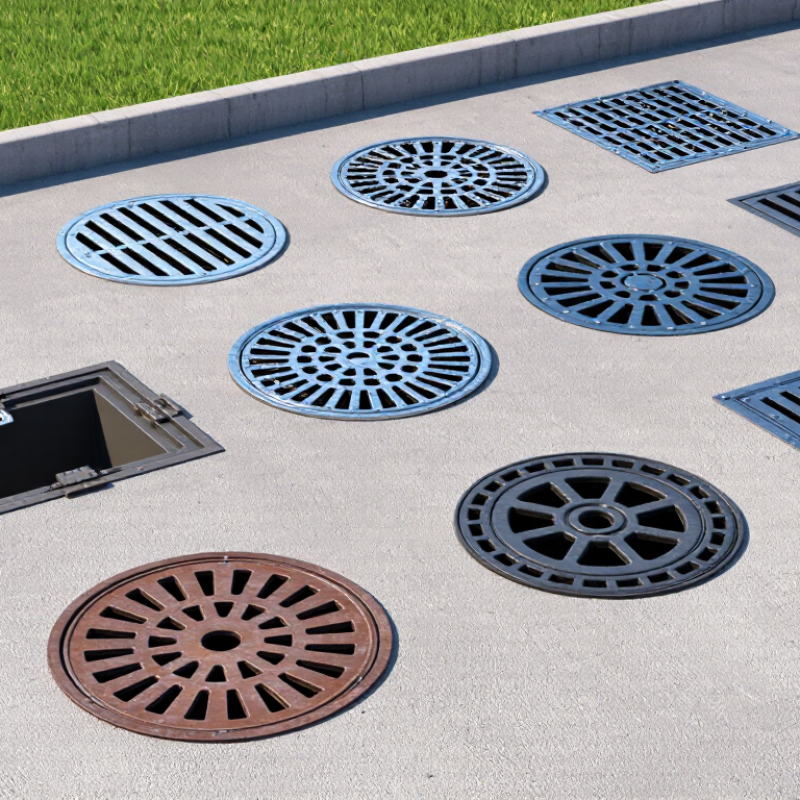
Sewer grates are removable covers that let stormwater enter underground drainage systems. They also block leaves, stones, and larger debris. Common types include cast iron, ductile iron, galvanized steel, stainless steel, aluminum, polymer concrete, fiberglass-reinforced plastic, slot, trench, and decorative grates. Each design serves a different location. A ductile iron grate suits road traffic, while a slot grate fits narrow pedestrian drainage channels.
Urban drainage matters more as cities expand. UN DESA projects that 68% of the world’s population will live in urban areas by 2050.
The World Bank’s Cities and Flooding report identifies flooding as the most frequent natural hazard.
A properly selected grate helps water leave roads quickly, reducing ponding near entrances, bus stops, and underground passages. Load class is critical. EN 124-2 rates drainage covers from pedestrian areas to heavy traffic zones. Openings also need practical spacing. Small gaps improve safety, but they may clog faster. This trade-off is often underestimated.
Tips: Check traffic loads, rainfall intensity, local standards, frame depth, and maintenance access. Measure the channel before ordering. Stainless steel may resist corrosion, but it is not always the most economical choice. A perfect grate does not exist. Field inspections should follow installation, because real debris patterns often differ from design assumptions. UN-Water reports that climate pressure is increasing water-related risks, making routine cleaning and inspection increasingly important.
Cast iron sewer grates remain a practical choice for heavy-traffic roads, loading bays, and industrial yards. Their high compressive strength handles repeated loads from buses, trucks, and forklifts. A stable frame also reduces rocking, impact noise, and pavement damage. Site inspections often show that poor frame seating causes more trouble than the grate itself.
Global buyers should match the grate’s load class with real traffic conditions, not only the product price. Check local drainage standards, opening dimensions, hydraulic capacity, and installation depth before ordering. A hinged or locking design can improve maintenance safety in busy areas. Protective coatings may slow corrosion, but they cannot replace proper drainage and routine inspection. Look closely at the bearing surfaces. Small casting defects can become serious under constant wheel pressure.
A heavier grate is not automatically better. Excessive weight may complicate lifting and delay cleaning work. In coastal or chemical-processing areas, corrosion resistance deserves special review because ordinary cast iron may deteriorate faster. One detail often needs reconsideration: narrow slots can improve surface safety, yet they may restrict water flow when leaves or waste collect. Buyers should request test records, dimensional tolerances, material details, and clear maintenance guidance from qualified suppliers. The final choice should reflect traffic frequency, environmental exposure, and the skills of local maintenance teams.
Top 10 Types of Sewer Grates for Global Buyers
Steel Sewer Grates for Strength, Flexibility, and Modern Design
Steel sewer grates remain a practical choice for streets, parking areas, walkways, and industrial yards. Their strength supports repeated traffic, while flexible designs suit different drainage demands. Common options include welded bar, press-locked, riveted, perforated plate, expanded metal, trench, hinged, bolted, anti-slip, and decorative steel grates. Each type manages water flow, loading, cleaning access, and appearance differently.
From field inspections, welded and press-locked grates often perform well in busy areas. Hinged models simplify maintenance beside roads, while perforated plates provide a more enclosed surface. Galvanized or coated steel can reduce corrosion, but drainage conditions still matter. Salt, standing water, and poor surface preparation may shorten service life. No grate choice is perfect. I have seen strong products fail when the frame was poorly fitted.
Tips: Confirm the clear opening, frame size, load requirement, and installation depth before ordering. Ask for material certificates, coating details, and dimensional drawings. Check local drainage rules and vehicle classifications with a qualified engineer. Anti-slip patterns help pedestrians, but overly small openings may collect leaves and sediment. Modern designs can look clean and precise. They still need regular inspection, especially after heavy rain or road repairs.
Among the top ten sewer grate types, stainless steel and aluminum suit corrosion-prone environments particularly well. Coastal roads, wastewater plants, food-processing areas, and chemical handling zones expose drainage covers to salt, moisture, and aggressive residues.
Stainless steel offers strong load capacity and a clean surface that is easy to inspect. Grade 316 usually performs better near seawater because of its higher molybdenum content. Grade 304 may suit sheltered locations with lower chloride exposure. Aluminum is lighter, easier to handle, and naturally forms a protective oxide layer. However, it can suffer from galvanic corrosion when installed beside incompatible metals. Do not judge performance by weight alone.
A reliable specification should include load class, opening size, frame depth, slip resistance, and drainage capacity. Ask for material certificates, coating details, and documented test results. Check whether the grate matches the surrounding concrete or channel system. Small dimensional errors can create rocking, noise, and trip hazards. This is often overlooked.
Field inspections also reveal blocked slots caused by leaves, sediment, or plastic waste. Narrow openings may look neat but require more maintenance. Wider openings improve flow, yet they can create safety concerns for pedestrians and small wheels. Site conditions must decide the pattern. In some projects, aluminum seemed ideal until heavy service vehicles changed the calculation. Corrosion resistance is important, but structural demands come first.
Top 10 Types of Sewer Grates for Global Buyers
Composite and plastic sewer grates offer a practical alternative to traditional metal products. They are lighter, corrosion-resistant, and easier to handle beside busy roads. A two-person crew can often position them without lifting equipment. That matters in narrow streets, coastal zones, and wastewater facilities.
The OECD Global Plastics Outlook reports that global plastic waste reached 353 million tonnes in 2019. This figure demands better material decisions, not careless substitution. Buyers should request recycled-content data, UV-resistance results, water-absorption tests, and documented load performance. EN 124 classifications can help define suitable applications, while project engineers should confirm local acceptance requirements. A grate for a pedestrian walkway should not be specified for heavy truck traffic.
Composite products also reduce transport weight and may lower installation costs. However, plastic-based materials can soften under extreme heat, deform after poor bedding, or become slippery when contaminated. Lightweight is not automatically safer. The World Bank’s What a Waste 2.0 report estimates that municipal solid waste could reach 3.40 billion tonnes annually by 2050. Durable drainage infrastructure will therefore face greater pressure.
I would not treat laboratory results as complete proof. Site drainage, frame support, sunlight, salt exposure, and maintenance habits can change performance. Buyers need traceable test reports, clear warranty terms, and replacement dimensions. Small details matter. A low-cost grate that shifts, cracks, or blocks flow creates a larger cost later.
| Grate Type | Primary Material | Typical Load Class* | Typical Applications | Key Advantages | Main Limitations | Indicative Unit Mass** |
|---|---|---|---|---|---|---|
| Molded Composite Grate | Glass-fiber-reinforced resin, commonly polyester or vinyl ester | A15–C250; engineered designs can reach higher ratings | Sidewalks, parking areas, campuses, wastewater facilities, and light-duty road drainage | Low weight, corrosion resistance, electrical non-conductivity, and reduced lifting requirements | Load capacity and long-term performance depend strongly on resin system, reinforcement, span, and support condition | Approximately 18–35 kg for a 600 × 600 mm assembly |
| Pultruded FRP Grating | Pultruded fiberglass-reinforced polymer profiles with resin matrix | A15–C250 for suitable designs | Industrial drainage channels, chemical plants, treatment works, and maintenance areas | High strength-to-weight ratio, good chemical resistance, and consistent structural profiles | Requires correct support spacing; cutting and fire performance must be checked for the project | Approximately 22–40 kg for a 600 × 600 mm assembly |
| Recycled Plastic Grate | High-density polyethylene or polypropylene, often incorporating post-consumer or post-industrial material | A15–B125; some reinforced systems are designed for C250 | Gardens, pedestrian zones, residential drainage, landscaping, and low-speed vehicle areas | Lightweight, rust-free, easy to handle, and suitable for wet environments | Lower stiffness and temperature resistance than metal; heavy-traffic use requires verified testing | Approximately 10–28 kg for a 600 × 600 mm assembly |
| Ductile Iron Grate | Spheroidal graphite cast iron, usually protected with a coating or paint system | B125–F900 depending on design and installation | Roadways, airports, industrial yards, ports, and heavy-traffic drainage points | High strength, impact resistance, and suitability for demanding traffic loads | Heavy to install, susceptible to corrosion without protection, and has a higher handling cost | Approximately 45–85 kg for a 600 × 600 mm assembly |
| Cast Iron Grate | Grey cast iron | A15–D400 depending on section thickness and design | Traditional urban drainage, sidewalks, courtyards, and low- to medium-traffic areas | Good compressive strength, dimensional stability, and established manufacturing availability | Brittle under severe impact, heavy compared with polymer products, and vulnerable to rust | Approximately 50–95 kg for a 600 × 600 mm assembly |
| Galvanized Steel Grate | Carbon steel protected by hot-dip galvanizing | A15–C250; higher classes require engineered construction | Linear drains, loading areas, plant rooms, service yards, and utility compounds | High stiffness, economical fabrication, and good resistance to atmospheric corrosion when intact | Coating can be damaged by abrasion or cutting; corrosion may occur at exposed edges and welds | Approximately 28–55 kg for a 600 × 600 mm assembly |
| Stainless Steel Grate | Stainless steel, commonly grades suitable for the specified environment | A15–C250 for typical drainage designs | Food-processing sites, hospitals, coastal locations, commercial kitchens, and hygienic facilities | Excellent cleanability, attractive appearance, and strong resistance to many corrosive environments | Higher material cost; grade selection is important in chloride-rich or chemically aggressive conditions | Approximately 25–50 kg for a 600 × 600 mm assembly |
| Aluminum Grate | Extruded or cast aluminum alloy | A15–B125; heavier-duty designs require specific structural verification | Pedestrian areas, marine facilities, rooftop drainage, and access zones where low weight is important | Very low density, corrosion resistance, and convenient manual handling | Lower hardness and stiffness than iron or steel; galvanic corrosion must be considered with dissimilar metals | Approximately 12–30 kg for a 600 × 600 mm assembly |
| Slot Drain Grate | Stainless steel, galvanized steel, polymer concrete, or composite sections | A15–D400 depending on channel and grate construction | Pedestrian plazas, commercial entrances, industrial floors, roads, and areas requiring discreet drainage | Narrow visible opening, efficient surface drainage, and a clean architectural appearance | Requires accurate installation and regular cleaning; hydraulic capacity depends on slot width and outlet design | Approximately 8–35 kg per 1 m section, depending on material and load rating |
| Anti-Slip Mesh Grate | Press-locked steel, serrated galvanized steel, aluminum, or FRP | A15–C250 for common access and drainage applications | Industrial walkways, ramps, platforms, treatment plants, and wet service areas | High slip resistance, open drainage area, ventilation, and easy visual inspection | Open mesh may allow small objects to fall through; foot comfort and heel safety must be checked in pedestrian zones | Approximately 15–40 kg per 1 m section |
* Load classes refer to the EN 124 classification range commonly used for access covers and gratings: A15 for pedestrian areas, B125 for footways and parking areas, C250 for kerbside channels, D400 for carriageways, and higher classes for specialized heavy-duty locations. The final rating depends on the complete grate-and-frame assembly, support conditions, dimensions, and installation quality.
** Unit masses are indicative estimates for comparison only. Actual weight varies with clear opening, frame depth, bar spacing, reinforcement, coating, and manufacturer design.
Rob was always very honest and upfront about everything and took the time to explain everything I needed.
“highly recommended. They provided us with a great storage container with ontime services.”
“Bought a used container, its perfect, no leaks and in good condition.”
“Good service and prompt delivery. A great option for temporary storage at a decent price.”

Join our mailing list to get the latest storage container inventory and offers