Submarine Hose is a critical link between offshore loading systems, floating terminals, and shore-based infrastructure. It must withstand seawater, pressure cycles, tanker movement, abrasion, and demanding transfer schedules. A small weakness can become a serious operational problem.
Market estimates vary. MarketsandMarkets projects steady growth in the marine hoses sector through 2028, supported by offshore energy, LNG, and port infrastructure investment. Grand View Research also identifies offshore transportation and energy projects as important demand drivers. These figures should be read carefully. Market boundaries differ between reports, and submarine hose data is rarely separated from broader marine hose categories.
Technical guidance matters more than marketing claims. OCIMF’s GMPHOM 2000 and ISO 1823 address hose design, testing, handling, and inspection. DNV’s offshore safety publications also emphasize documented assurance across the asset life cycle. David Baird, Global Segment Director at Trelleborg Marine & Infrastructure, has stated, “Hose integrity depends on the entire operating system, not only the hose itself.” That principle deserves attention.
This guide examines ten Submarine Hose manufacturers serving global buyers. It compares engineering capability, material quality, testing practices, certifications, delivery reach, and after-sales support. Real projects are rarely perfect. Supplier websites can overstate strengths, while public data may remain incomplete. Buyers should verify certificates, inspection records, operating temperature ranges, bend-radius limits, and replacement procedures before making a final decision. A strong shortlist begins with evidence, not attractive specifications.
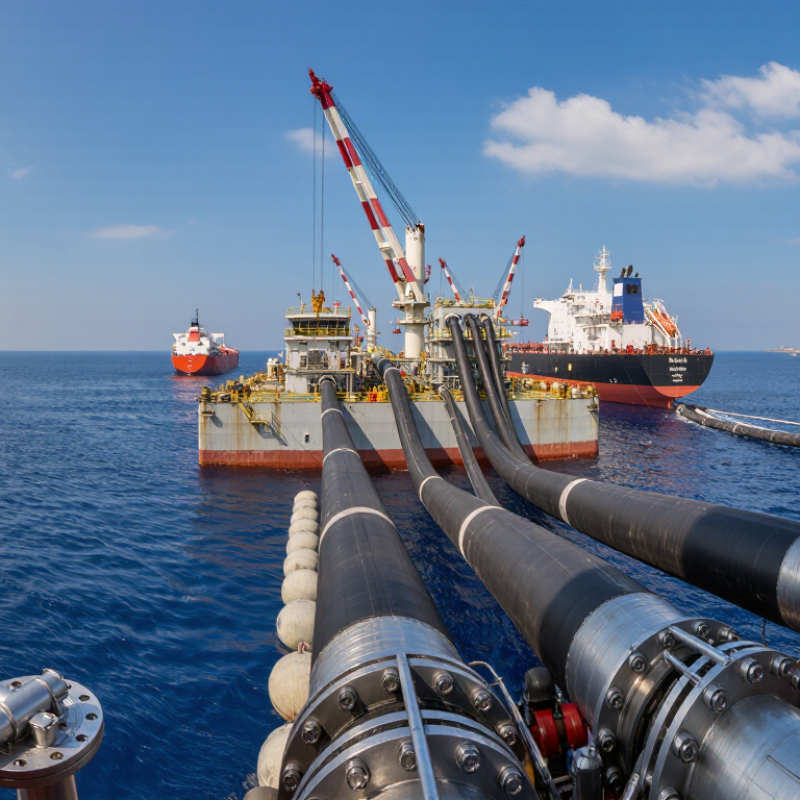
Submarine Hose Manufacturing: Purpose, Design, and Industry Applications
Submarine hoses transfer fluids between offshore structures, vessels, and underwater systems. They must survive pressure, saltwater, movement, and repeated bending. A reliable design begins with the service fluid, operating depth, temperature, and flow rate. Engineers then select compatible tube materials, reinforcement layers, covers, and end fittings. Every layer has a job. Nothing is decorative.
Manufacturers serving global buyers often test burst pressure, fatigue resistance, leakage, buoyancy, and connector performance. Flexible hose assemblies may support offshore loading, dredging, marine fuel transfer, seawater intake, or industrial discharge operations. Reinforcement controls pressure. External covers resist abrasion and sunlight. Buoyancy modules can prevent excessive bending near the seabed. Installation quality still matters. Even a strong hose can fail after poor routing or an incorrect bend radius. No design is perfect. Conditions change, and field evidence should improve the next specification.
Tips: Ask for material compatibility data, pressure ratings, bend-radius limits, and inspection records. Confirm whether testing reflects real depth and movement. Check fittings carefully; small dimensional errors can create serious leakage risks. Keep maintenance logs with dates, photographs, and operating conditions. A practical review by experienced marine engineers is valuable, especially when the hose crosses different water depths or connects moving equipment.
Nominal bore is the internal diameter used to specify marine and submarine hose assemblies. These standard size increments are commonly selected according to cargo flow rate, pumping capacity, pressure requirements, vessel or terminal connection dimensions, and installation constraints. Actual availability and operating limits depend on the applicable marine hose specification and project design.
Global buyers should evaluate submarine hose manufacturers beyond catalog claims. UNCTAD’s Review of Maritime Transport 2023 reports that over 80% of global trade by volume moves by sea. Hose failure can therefore interrupt expensive, time-sensitive operations. A capable manufacturer should provide pressure ratings, bend-radius limits, buoyancy data, temperature ranges, and verified fatigue performance. Ask for certificates covering raw materials, reinforcement layers, end fittings, and factory testing. ISO compliance is useful, but it should not replace project-specific validation.
OCIMF’s GMPHOM 2009 remains a practical reference for offshore hose manufacturing and purchasing. Compare each supplier against its inspection, hydrostatic testing, traceability, and emergency-response procedures. DNV’s Maritime Forecast to 2050 also highlights stronger pressure for safer, more efficient maritime assets. That pressure reaches hose procurement. A reliable manufacturer should explain its inspection intervals and field-service capacity, not only its production volume. A polished brochure proves little. This is easy to underestimate.
Tips: Request three recent project references with similar water depth, cargo, pressure, and operating temperature. Check whether test records identify batch numbers and inspectors. Review spare-part availability near the installation site. Ask how the supplier handles design changes after approval. Do not select the lowest quotation automatically; lifecycle cost often reveals a different result. Also, leave room for doubt. Some specifications look complete until installation conditions expose missing assumptions.
Global submarine hose manufacturing requires more than rubber forming and metal reinforcement. Leading suppliers typically combine marine engineering, polymer science, and field-service experience. Their products may support offshore loading, dredging, cooling-water transfer, or subsea discharge systems. Each manufacturer must control buoyancy, pressure resistance, bending performance, and seawater aging. Small errors matter.
The first profile represents a European specialist focused on low-temperature flexibility and strict production traceability. Another serves Asian shipyards with high-volume, customized hose assemblies.
A North American manufacturer emphasizes reinforced floating hoses for offshore terminals. A Scandinavian producer develops abrasion-resistant designs for harsh northern waters.
One Mediterranean company specializes in compact systems for restricted port areas. A Middle Eastern supplier prioritizes heat resistance and rapid regional delivery.
An East Asian manufacturer combines automated inspection with competitive production. An Australian producer focuses on coral-sensitive installation planning and service access.
A Central European engineering group provides detailed fatigue calculations. The final profile reflects a global custom-build supplier handling unusual lengths, connectors, and buoyancy requirements.
Reliable buyers should examine more than catalog pressure ratings.
They should request burst-test records, material certificates, dimensional reports, and installation guidance. Factory acceptance testing can reveal alignment problems before shipment.
Useful questions concern bending radius, ballast placement, cover wear, and emergency replacement time. Field feedback is equally valuable, although it is rarely complete.
Some suppliers publish impressive figures but explain little about long-term failures. That gap deserves attention.
A careful comparison should include lifecycle cost, inspection support, spare-part availability, and documented compliance with applicable marine standards.
For global buyers, the top 10 submarine hose manufacturers should be compared through evidence, not attractive catalogs. UNCTAD’s Review of Maritime Transport 2024 states that over 80% of world merchandise trade by volume moves by sea. Hose failure can therefore disrupt ports, terminals, and offshore transfer schedules. Product quality begins with documented rubber compounds, reinforcement design, bend-radius testing, and traceability from raw material to finished assembly. Buyers should check compliance with OCIMF GMPHOM 2009, relevant ISO standards, and project-specific classification requirements. ISO 9001 supports process control, but it does not guarantee every hose performs perfectly. That distinction matters.
Capacity also needs practical measurement. Ask about available bore sizes, pressure ratings, annual production, testing equipment, and inspection staffing. A factory may claim high output, yet struggle with customized flanges or short production windows. Delivery support should include confirmed lead times, export packing, spare gaskets, installation guidance, and emergency replacement procedures. DNV or equivalent inspection evidence can strengthen confidence, especially for offshore applications. However, certification is only a snapshot. Recent test records are more useful than old certificates.
Tips: Request three recent inspection reports, not one. Confirm whether delivery dates include testing, packing, and port clearance. Check the manufacturer’s ability to provide serial-number traceability and field support. A realistic supplier should also explain its weak points. That honesty is often more valuable than a perfect sales presentation.
Top 10 Submarine Hose Manufacturers for Global Buyers
Key Factors Global Buyers Should Check Before Placing an Order
Global buyers should examine service conditions before comparing prices. Confirm working pressure, burst pressure, temperature range, bend radius, fluid type, and installation depth. A hose designed for calm harbor transfer may fail during offshore deployment. IRENA’s Renewable Capacity Statistics 2024 recorded more than 75 GW of global offshore wind capacity by the end of 2023. This growth increases demand for reliable subsea fluid-transfer systems. However, renewable projects often use different fluids, connectors, and inspection schedules than oil terminals.
Check whether each manufacturer provides traceable materials and documented testing. Ask for reinforcement details, cover compounds, end-fitting drawings, and batch certificates. Verification should include hydrostatic testing, vacuum resistance, fatigue testing, and dimensional inspection. API Specification 17K and ISO 13628-5 provide useful references for flexible pipe design and qualification. DNV’s Energy Transition Outlook 2024 also projects continued expansion in offshore energy infrastructure. That forecast supports long-term demand, but it does not prove every supplier can manage deepwater conditions. Buyers should request project references with similar depth, pressure, and fluid exposure.
Tips: Ask for a sample inspection plan before signing. Check how failures are reported and corrected. A low quotation can hide expensive testing gaps. I have seen procurement teams focus heavily on delivery dates, then overlook spare lengths and replacement connectors. That decision may save weeks initially, but it can extend downtime later. Review warranty limits carefully, especially for abrasion, chemical swelling, and repeated bending. Also confirm packaging, storage life, export documents, and technical support in the installation region.
Comparative buyer-screening table using anonymous manufacturer profiles. Capability ranges are representative of commonly specified submarine, offshore loading, dredging, and marine oil-transfer hose products and must be confirmed against the supplier’s current technical datasheet and project quotation.
| Rank | Anonymous Manufacturer Profile | Typical Submarine Hose Configuration | Common Nominal Bore | Typical Working Pressure | Temperature Capability | Relevant Standards and Approvals | Reinforcement and Construction | Quality Documents to Request | Customization Options | Indicative Lead Time | Critical Buyer Check |
|---|---|---|---|---|---|---|---|---|---|---|---|
| 1 | Profile A – Offshore Fluid-Transfer Specialist | Submarine oil-transfer hose strings, floating hose sections, tanker-loading assemblies, and end fittings | 6–24 in (150–600 mm) | 10–21 bar working pressure; project-specific burst testing | Approximately −29°C to +82°C, depending on lining and fluid | OCIMF GMPHOM 2009, ISO 1823, EN 1765, customer marine specifications | Multiple textile reinforcement layers, abrasion-resistant cover, buoyancy or ballast options | Material certificates, hydrostatic test report, dimensional report, traceability records, inspection plan | Length, flange pattern, bend restrictors, buoyancy modules, electrical continuity, leak-detection provisions | 12–20 weeks after approved drawings | Confirm complete hose-string design responsibility and interface calculations |
| 2 | Profile B – Large-Bore Marine Hose Producer | Large-bore submarine discharge hoses for crude oil, fuel oil, and compatible marine products | 8–24 in (200–600 mm) | 15–21 bar working pressure | Approximately −30°C to +80°C | ISO 1823, EN 1765, OCIMF-related project requirements | Heavy-duty elastomer tube, high-strength textile carcass, external abrasion and weathering cover | Factory acceptance test, hose identification records, rubber compound data, pressure-test certificate | High-bore tooling, custom flange drilling, reduced-bend-radius sections, special cover compounds | 14–24 weeks | Check minimum bend radius under both empty and operating conditions |
| 3 | Profile C – Dredging and Offshore Discharge Specialist | Submarine dredging hoses, seawater discharge hoses, slurry-transfer hoses, and reinforced marine pipelines | 6–20 in (150–500 mm) | 7–16 bar working pressure | Approximately −25°C to +80°C | ISO 1823 where applicable, EN 1765 for oil service, project dredging specifications | Thick wear-resistant tube, textile or wire reinforcement, optional embedded steel rings | Abrasion test data, compound certificate, wall-thickness report, pressure test, batch traceability | Extra-thick tube, ceramic or high-abrasion lining, floating sections, quick-connect couplings | 8–18 weeks | Match lining compound and abrasion resistance to solids concentration and particle size |
| 4 | Profile D – High-Pressure Offshore Hose Supplier | High-pressure submarine transfer hoses for refined products, marine fuel, and offshore terminal service | 4–16 in (100–400 mm) | 16–25 bar working pressure, subject to design and testing | Approximately −40°C to +100°C, fluid-dependent | ISO 1823, EN 1765, selected offshore operator specifications | Multi-layer textile reinforcement with high-pressure carcass and protective outer cover | Design calculation, proof-test report, burst-test evidence, inspection and test plan, certificate of conformity | Low-temperature compounds, chemical-resistant liners, special end fittings, bend stiffeners | 16–26 weeks | Verify pressure rating at the actual operating temperature and fluid composition |
| 5 | Profile E – Floating and Submarine Hose Assembly Manufacturer | Complete hose assemblies combining floating sections, submarine sections, reducers, and marine couplings | 6–20 in (150–500 mm) | 10–21 bar working pressure | Approximately −29°C to +80°C | OCIMF GMPHOM 2009 project criteria, ISO 1823, EN 1765 | Buoyancy-integrated or external flotation, reinforced hose body, marine-grade couplings | Assembly drawings, buoyancy calculations, hydrostatic test, electrical continuity test, NDE records | Custom buoyancy, marker systems, swivel joints, breakaway couplings, monitoring accessories | 14–22 weeks | Review flotation stability, submerged weight, current loads, and connection loads |
| 6 | Profile F – Chemical and Fuel Transfer Hose Producer | Submarine hoses for diesel, marine gas oil, lubricants, selected chemicals, and fuel-terminal transfer | 3–12 in (75–300 mm) | 10–20 bar working pressure | Approximately −35°C to +100°C, depending on chemical compatibility | ISO 1823, EN 1765, chemical-resistance requirements, customer HSE specifications | Oil-resistant or chemical-resistant elastomer lining with textile or wire reinforcement | Chemical-compatibility declaration, permeation data, pressure test, material certificates, batch records | Conductive tube, flame-resistant cover, cold-weather formulation, special couplings and gaskets | 10–18 weeks | Obtain written compatibility confirmation for every fluid, additive, and cleaning chemical |
| 7 | Profile G – Heavy-Duty Rubber Hose Manufacturer | Robust submarine discharge hoses for ports, terminals, shipyards, and general offshore handling | 4–18 in (100–450 mm) | 10–16 bar working pressure | Approximately −25°C to +80°C | ISO 1823 or EN 1765 when specified by the service application | Heavy rubber cover, high-tensile textile reinforcement, reinforced end sections | Factory inspection report, pressure-test record, dimensional inspection, rubber batch traceability | Length and bore variations, flange adapters, cover colors, lifting eyes, protective sleeves | 8–16 weeks | Confirm end-fitting retention, lifting arrangement, and handling loads during installation |
| 8 | Profile H – Engineered Offshore Hose Systems Provider | Application-engineered submarine hose systems for offshore platforms, terminals, and CALM or SPM operations | 6–24 in (150–600 mm) | 10–21 bar working pressure | Approximately −30°C to +82°C | OCIMF GMPHOM 2009, ISO 1823, EN 1765, operator-specific engineering standards | Designed hose string with reinforced carcass, bend-control components, and engineered end assemblies | Finite-element or design calculations, ITP, FAT dossier, hydrostatic test, inspection certificates | Full system engineering, hose-string layout, monitoring, buoyancy, swivel and emergency release interfaces | 18–30 weeks | Ask whether engineering, installation supervision, and commissioning support are included |
| 9 | Profile I – OEM and Replacement Hose Specialist | Replacement submarine hose assemblies matching existing terminal, vessel, or offshore equipment interfaces | 4–16 in (100–400 mm) | 10–21 bar working pressure | Approximately −29°C to +80°C | ISO 1823, EN 1765, original-equipment interface requirements | Construction selected to replicate existing hose dimensions, reinforcement, and connection geometry | Reverse-engineering report, dimensional survey, pressure-test certificate, conformity statement | Like-for-like replacement, flange and coupling matching, modified lengths, upgraded cover materials | 6–14 weeks for standard designs; longer for new tooling | Provide accurate drawings, photographs, identification markings, and service history |
| 10 | Profile J – Regional Marine Hose Assembly Factory | Short-run and replacement submarine hose assemblies for marine contractors and port operators | 3–12 in (75–300 mm) | 10–16 bar working pressure | Approximately −20°C to +80°C | Applicable ISO or EN hose standards, port and vessel-owner specifications | Textile-reinforced hose, abrasion-resistant cover, crimped or flanged end connections | Pressure-test report, inspection checklist, material declaration, certificate of conformity | Short lengths, replacement couplings, custom gaskets, protective covers, expedited assembly | 4–10 weeks, subject to component availability | Audit testing equipment, calibration status, traceability, and subcontracted processes |
Rob was always very honest and upfront about everything and took the time to explain everything I needed.
“highly recommended. They provided us with a great storage container with ontime services.”
“Bought a used container, its perfect, no leaks and in good condition.”
“Good service and prompt delivery. A great option for temporary storage at a decent price.”

Join our mailing list to get the latest storage container inventory and offers