Choosing an On Board Marine Charger is not just about finding the highest amperage. The right unit should match your battery chemistry, bank size, and typical time at the dock. A small fishing boat with one battery has different needs from a cruiser running several banks. Check the details. Charging stages, output, and temperature protection can all affect everyday performance.
This guide compares ten marine chargers through practical features, including supported battery types, charging capacity, installation needs, and weather resistance. It also considers how clearly each model communicates its limits. A charger’s listed output may not tell the whole story when several batteries share power. Fit and wiring matter, too. For weekend boaters, straightforward controls can be more useful than a long feature list. For longer trips, dependable charging and suitable protection deserve closer attention. No single model suits every vessel, and product specifications can change. That is worth remembering. Use the comparison as a starting point, then confirm compatibility with your battery manufacturer’s guidance and the charger’s current documentation. A careful match can help keep batteries ready without adding unnecessary complexity aboard.
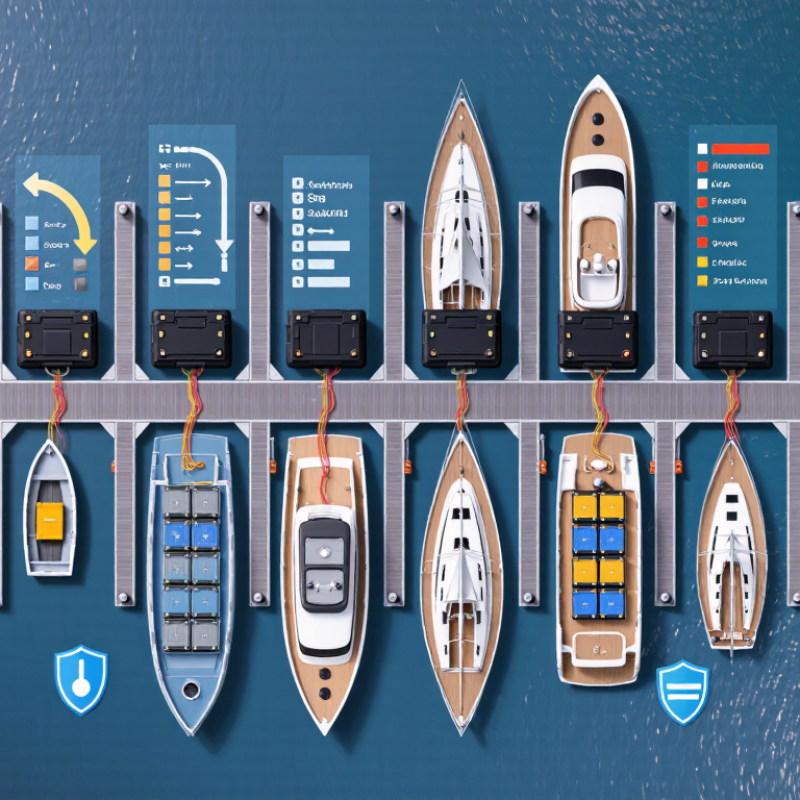
An onboard marine charger converts shore-power AC into regulated DC for a boat’s battery banks. A transformer or switching circuit changes the voltage, while control electronics adjust charging as batteries fill. Multi-bank models can supply separate outputs to starting and house batteries. They should match each bank’s chemistry and rated voltage; a lead-acid charging profile may undercharge or damage a lithium battery.
Many chargers use bulk, absorption, and float stages. Bulk delivers higher current to a low battery; absorption tapers current as voltage rises; float maintains charge. Temperature sensing matters, since battery charging limits shift with heat and cold. The U.S. Department of Energy’s 2023 Grid Energy Storage Technology Cost and Performance Assessment reports roughly 85–95% round-trip efficiency for lithium-ion storage systems, depending on configuration. That is a system-level benchmark, not a guaranteed onboard charger efficiency. Not a promise.
In practice, cable length, corrosion, ventilation, and battery condition affect results. A charger may show “full” while a distant battery receives less voltage through undersized wiring. Check manufacturer specifications, fuse protection, and terminal condition, then verify charging voltage at the battery with a meter. The boat’s wiring is rarely as tidy as a diagram. That detail is easy to miss.
The entries below are representative charger configurations, not specific retail products. Output ratings are illustrative common options; check a charger’s actual specifications, battery requirements, and installation instructions before purchase or use.
| No. | Charger configuration | Nominal battery system | Output rating | Charging banks | Typical battery compatibility | Best suited for | How it works |
|---|---|---|---|---|---|---|---|
| 1 | Compact single-bank charger | 12 V | 5 A total | 1 | Lead-acid types; lithium only when a compatible profile is specified | Small boats and occasional charging of one battery | Connects to shore-side AC power and supplies a controlled DC charging current. Many models adjust charging as the battery fills. |
| 2 | Standard single-bank charger | 12 V | 10 A total | 1 | Flooded, AGM, or gel lead-acid when the selected setting matches the battery; compatible lithium models can charge lithium batteries | A single starting or house battery on a small-to-medium boat | A charging controller regulates voltage and current, commonly using bulk, absorption, and maintenance or float stages for supported lead-acid batteries. |
| 3 | Higher-output single-bank charger | 12 V | 15 A total | 1 | Battery chemistry and capacity must fall within the charger’s stated limits | A larger single battery or a boat that needs quicker dockside replenishment | Provides more charging current than a low-output unit, subject to the battery’s accepted charge rate and the charger’s temperature limits. |
| 4 | Dual-bank compact charger | 12 V per bank | 5 A per bank; 10 A combined maximum | 2 | Use only with battery types supported by the charger; settings may need to match each bank | Separate starting and house batteries on smaller boats | Two outputs charge separate battery banks. On isolated-bank designs, each output is electrically separated to support independent batteries. |
| 5 | Dual-bank general-purpose charger | 12 V per bank | 10 A per bank; 20 A combined maximum | 2 | Supported lead-acid types; lithium only with a compatible charging profile and battery-management requirements | Boats with separate starting and house banks, or two independently charged batteries | Each bank receives a controlled output. Some chargers can monitor banks independently; follow the model’s wiring and battery-selection guidance. |
| 6 | Three-bank fishing-boat charger | 12 V per bank | 10 A per bank; 30 A combined maximum | 3 | Battery chemistry must be supported for each connected bank | A starting battery and two trolling-motor batteries | Multiple outputs allow several batteries to be charged from one AC connection. A 12 V charger output is not, by itself, a 24 V output. |
| 7 | Three-bank higher-output charger | 12 V per bank | 15 A per bank; 45 A combined maximum | 3 | Choose compatible battery profiles and confirm that each battery can accept the charging current | Boats with larger battery banks or regular, intensive use | Delivers a higher rated current to each supported bank. Actual charging time varies with battery capacity, state of charge, temperature, and charge limits. |
| 8 | Four-bank multi-battery charger | 12 V per bank | 10 A per bank; 40 A combined maximum | 4 | Only battery types and configurations approved by the charger manufacturer | Boats with several independent batteries, such as house, starting, and auxiliary banks | Charges multiple banks through separate outputs. Check whether outputs are isolated and whether the charger supports different chemistries at the same time. |
| 9 | 24 V single-bank charger | 24 V | 10 A total | 1 | 24 V battery bank of a chemistry explicitly supported by the charger | A 24 V trolling-motor or house bank | Uses a charging profile designed for a 24 V nominal bank. It is not interchangeable with a 12 V charger; observe the battery and wiring configuration. |
| 10 | 36 V single-bank charger | 36 V | 10 A total | 1 | 36 V battery bank of a chemistry explicitly supported by the charger | A 36 V trolling-motor battery bank | Regulates charging for a 36 V nominal bank. Use only with the correct battery arrangement and a charger rated for that system voltage. |
Rob was always very honest and upfront about everything and took the time to explain everything I needed.

“highly recommended. They provided us with a great storage container with ontime services.”
“Bought a used container, its perfect, no leaks and in good condition.”
“Good service and prompt delivery. A great option for temporary storage at a decent price.”