Choosing the right Industrial Lithium Battery is not simply a matter of selecting the highest capacity. It requires a careful match between the battery, equipment, environment, and daily workload. A warehouse forklift may need rapid charging and high cycle life. A remote monitoring system may prioritize low self-discharge and stable long-term storage. The details matter.
Battery expert JB Straubel once said, “The battery is the most important component of an electric vehicle.” His observation also applies to industrial systems, where battery performance can affect productivity, safety, and operating costs. A suitable Industrial Lithium Battery should provide consistent voltage under load, reliable thermal control, and a properly configured battery management system. Check the chemistry, rated capacity, peak current, charging time, cycle-life data, and operating temperature range. Do not trust capacity figures alone. A battery labeled 100 Ah may perform poorly if its discharge rate, cooling design, or BMS protection is unsuitable.
Look closely at the real workplace. Dust may enter charging areas. Cold storage rooms can reduce available power. Repeated short charging sessions may change the expected service life. These conditions should influence the final specification. Supplier documentation, test reports, warranty terms, and technical support also deserve attention. A low purchase price can become expensive after frequent replacements or unexpected downtime.
Some choices remain imperfect. Laboratory results do not always reflect an uneven warehouse floor or a rushed charging schedule. That is why pilot testing, maintenance records, and honest performance comparisons are essential. Choose evidence over impressive claims. Reliability is built through details.
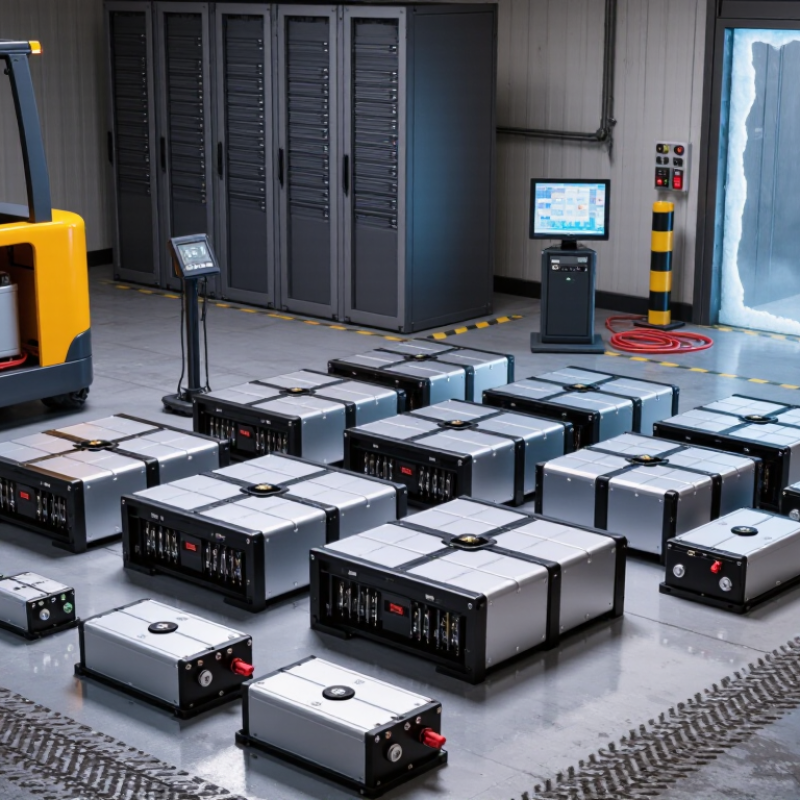
Selecting an industrial lithium battery starts with the equipment’s real workload, not its label. Measure the load. Record operating voltage, average current, and peak demand during startup or lifting. A motor may draw twice its normal current for several seconds. That brief surge can affect battery size, protection settings, and cable selection.
Calculate energy demand from voltage, current, and operating hours. For example, a 48-volt system drawing 20 amps for four hours needs about 3.84 kilowatt-hours before practical losses. Include inverter efficiency, cold temperatures, and the usable depth of discharge. Runtime estimates often look too optimistic on paper.
Match the battery voltage to the machine and charger. An incorrect voltage can damage equipment or create unsafe charging conditions. Check continuous and peak current ratings against the controller’s requirements. Allow capacity for aging, heavy workloads, and unexpected delays. A warehouse vehicle may need extra runtime during a busy shift. Monitor actual voltage and current during testing, then compare the results with the calculated model. Specifications guide the decision, but measured performance should have the final influence.
Choosing an industrial lithium battery starts with chemistry, not advertised capacity. Lithium iron phosphate (LFP) offers strong thermal stability, long cycle life, and lower material cost. The International Energy Agency reported that LFP represented nearly 40% of global electric-car battery deployments in 2023. That scale supports growing supply confidence, although industrial duty cycles differ from vehicle use.
Nickel manganese cobalt (NMC) provides higher energy density where space is limited. However, it demands careful thermal management and usually costs more. Lithium titanate (LTO) accepts rapid charging and frequent cycling, making it suitable for cranes, automated warehouses, and grid-support equipment. Its lower energy density can require a larger cabinet. BloombergNEF reported an average lithium-ion battery pack price of $115 per kWh in 2024, but this figure does not equal a complete industrial system price. Integration, cooling, controls, and safety testing can change the calculation.
A practical comparison should examine cycle frequency, ambient temperature, charging windows, and required runtime. A cold warehouse may expose weaknesses that a laboratory test misses. LFP is not automatically the safest choice in every installation. NMC is not automatically inefficient. The spreadsheet may still be wrong. I would request independently verified cycle data, usable capacity at the target temperature, and clear end-of-life definitions. The U.S. Department of Energy’s battery research emphasizes that lifetime depends heavily on operating conditions, not chemistry alone.
| Lithium Chemistry | Nominal Cell Voltage | Typical Gravimetric Energy Density | Typical Cycle Life1 | Thermal Stability | Continuous Charge Rate | Recommended Operating Temperature2 | Relative Cost | Main Advantages | Typical Industrial Applications |
|---|---|---|---|---|---|---|---|---|---|
| Lithium Iron Phosphate (LFP / LiFePO4) | 3.2–3.3 V | 90–160 Wh/kg | 2,000–7,000 cycles | ★★★★★ Very high stability; high resistance to thermal runaway compared with nickel- and cobalt-based chemistries. | Typically 0.5C–1C | Charge: 0°C to 45°C Discharge: −20°C to 60°C | Low to medium | Long service life, strong safety profile, good power capability, and reduced reliance on nickel and cobalt. | Stationary energy storage, forklifts, automated guided vehicles, material-handling equipment, telecom backup, microgrids, and low-speed commercial vehicles. |
| Nickel Manganese Cobalt Oxide (NMC / LiNiMnCoO2) | 3.6–3.7 V | 150–250 Wh/kg | 1,000–3,000 cycles | ★★★☆☆ Good when correctly managed, but requires robust thermal and battery-management controls. | Typically 0.5C–1C | Charge: 0°C to 45°C Discharge: −20°C to 55°C | Medium to high | High energy density, compact design, and a strong balance between power and energy performance. | Electric industrial vehicles, robotics, mobile machinery, aerospace-support equipment, compact backup systems, and applications where space and weight are limited. |
| Lithium Titanate (LTO / Li4Ti5O12) | 2.3–2.4 V | 50–90 Wh/kg | 10,000–30,000 cycles | ★★★★★ Excellent thermal stability and very low risk of lithium plating during high-rate charging. | Typically 2C–10C | Charge: −30°C to 55°C Discharge: −30°C to 55°C | High | Extremely long cycle life, rapid charging, excellent low-temperature performance, and high power capability. | Opportunity-charging buses, port equipment, high-use forklifts, regenerative-power systems, frequency regulation, and systems requiring frequent fast charge and discharge. |
| Nickel Cobalt Aluminum Oxide (NCA / LiNiCoAlO2) | 3.6–3.7 V | 180–260 Wh/kg | 1,000–2,000 cycles | ★★★☆☆ High energy performance, but strict control of temperature, voltage, and charging conditions is essential. | Typically 0.5C–1C | Charge: 0°C to 45°C Discharge: −20°C to 55°C | Medium to high | Very high energy density and relatively low weight for applications with demanding range or runtime requirements. | Specialized mobile equipment, high-end industrial vehicles, aerospace-support systems, and weight-sensitive power modules. |
| Lithium Manganese Oxide (LMO / LiMn2O4) | 3.7–3.8 V | 90–150 Wh/kg | 500–2,000 cycles | ★★★★☆ Better thermal stability than many nickel-rich chemistries, with moderate energy retention. | Typically 0.5C–2C | Charge: 0°C to 45°C Discharge: −20°C to 55°C | Low to medium | Good power output, moderate cost, and relatively stable thermal behavior. | Power tools, medical equipment, hybrid battery packs, light industrial machinery, and applications needing moderate power at controlled duty cycles. |
| Lithium Manganese Iron Phosphate (LMFP) | 3.4–3.5 V | 120–190 Wh/kg | 2,000–5,000 cycles | ★★★★☆ Generally strong thermal stability, similar to LFP, with performance dependent on cell design and operating conditions. | Typically 0.5C–1C | Charge: 0°C to 45°C Discharge: −20°C to 60°C | Low to medium | Potentially higher energy density than conventional LFP while retaining good safety and cycle-life characteristics. | Stationary storage, industrial vehicles, robotics, backup power, and applications seeking a compromise between LFP safety and higher usable energy. |
1 Cycle-life figures are typical industry ranges under controlled conditions and may vary with depth of discharge, temperature, charge rate, discharge rate, and end-of-life criteria. 2 Temperature ranges are representative cell-level values; the battery-management system, enclosure, cooling, and manufacturer specifications determine the allowable operating limits for a complete battery pack.
How to Choose the Right Industrial Lithium Battery?
Evaluate Safety, Durability, and Operating Conditions
Safety should be assessed before capacity or purchase price. Check cell protection, thermal controls, enclosure strength, and fault monitoring. A reliable battery should prevent overcharging, deep discharge, overheating, and short-circuit damage. Review test records, inspection procedures, and compliance with applicable industrial safety standards. Do not rely on a specification sheet alone.
Durability depends on real work, not laboratory claims. Examine expected cycle life at your actual discharge depth and load pattern. A warehouse vehicle may face hundreds of shallow cycles, while emergency equipment may remain idle for months. Ask how capacity changes over time. Confirm service access, diagnostic data, and replacement procedures. I have seen systems fail early because charging schedules were copied from another application.
Operating conditions often reveal the better choice. Record ambient temperature, humidity, vibration, dust, and available ventilation. Cold environments can reduce power, while heat accelerates aging. Match the battery management system to the charger and equipment controls. Allow space for inspection and safe maintenance. Small details matter.
No spreadsheet captures every surprise. Field trials are valuable. Run the battery through a representative shift, including peak loads and charging pauses. Measure temperature, voltage stability, and remaining capacity. Be willing to revise the original selection when evidence disagrees with expectations. That uncomfortable step can prevent a costly installation mistake.
Choosing an industrial lithium battery starts with the charging system, not the catalogue capacity. Confirm the charger’s voltage range, current limit, connector, communication protocol, and charging curve. A battery rated at 48 volts may still reject a charger with unsuitable termination settings. Check the site temperature, cable length, and daily duty cycle. Small mismatches create heat.
Battery management deserves equal attention. A practical BMS should monitor cell voltage, temperature, current, state of charge, and fault history. It should also communicate clearly with the charger or equipment controller. The International Energy Agency reported that battery demand in the energy sector reached nearly 750 GWh in 2023. That scale increases the need for traceable testing and dependable monitoring. Yet, a polished data sheet cannot prove field reliability. Request cycle-life conditions, low-temperature limits, alarm logic, and service records.
Compatibility extends beyond voltage. Compare peak loads, regenerative charging, enclosure dimensions, mounting points, and software signals. BloombergNEF’s 2024 Battery Price Survey placed the average lithium-ion pack price at 115 dollars per kWh, a 20% annual decline. Lower prices can improve project economics, but they may encourage rushed substitutions. Test the complete battery, charger, and load together. Keep records. Recheck assumptions after installation, because real operating patterns rarely match the original spreadsheet.
How to Choose the Right Industrial Lithium Battery?
Assess Total Cost, Maintenance, and Supplier Support
When comparing industrial lithium batteries, purchase price is only the opening line. Total cost includes chargers, installation, energy losses, training, inspections, spare modules, and eventual recycling. A battery costing less may require extra labor or cause longer charging interruptions. Ask for a five-year cost model based on your shift pattern, load weight, and ambient temperature. Use actual meter readings when possible. Estimates can mislead.
Maintenance deserves equal attention. Check whether the system provides cell-level alerts, temperature records, and clear fault codes. Ask who can diagnose a failed module and how quickly replacement parts arrive. A practical trial should measure charging time, usable capacity, and performance during peak workloads. Keep inspection access simple. Technicians should not need to remove unrelated equipment. Small details matter. Maintenance plans can fail when nobody owns daily visual checks.
Supplier support can protect operations after installation. Review warranty limits, response targets, remote assistance, on-site training, and software update procedures. Request service contacts, escalation paths, and written responsibilities. Ask whether support remains available across multiple operating shifts. A polished proposal is not proof of dependable service. Speak with current users when permitted, and compare documented service records rather than promises. The best choice is not always the newest battery. It is the system your team can operate, maintain, and afford under real conditions.
Assess total cost, maintenance requirements, and supplier support before making a purchasing decision.
Illustrative industry benchmark model using typical published ranges for lithium battery efficiency, cycle life, maintenance, and industrial electricity costs. Values are not associated with any specific company or brand.
Rob was always very honest and upfront about everything and took the time to explain everything I needed.
“highly recommended. They provided us with a great storage container with ontime services.”
“Bought a used container, its perfect, no leaks and in good condition.”
“Good service and prompt delivery. A great option for temporary storage at a decent price.”

Join our mailing list to get the latest storage container inventory and offers